Projects

Below is a selection of work that reflects how I think about software: structure, maintainability, usability, and long-term quality.

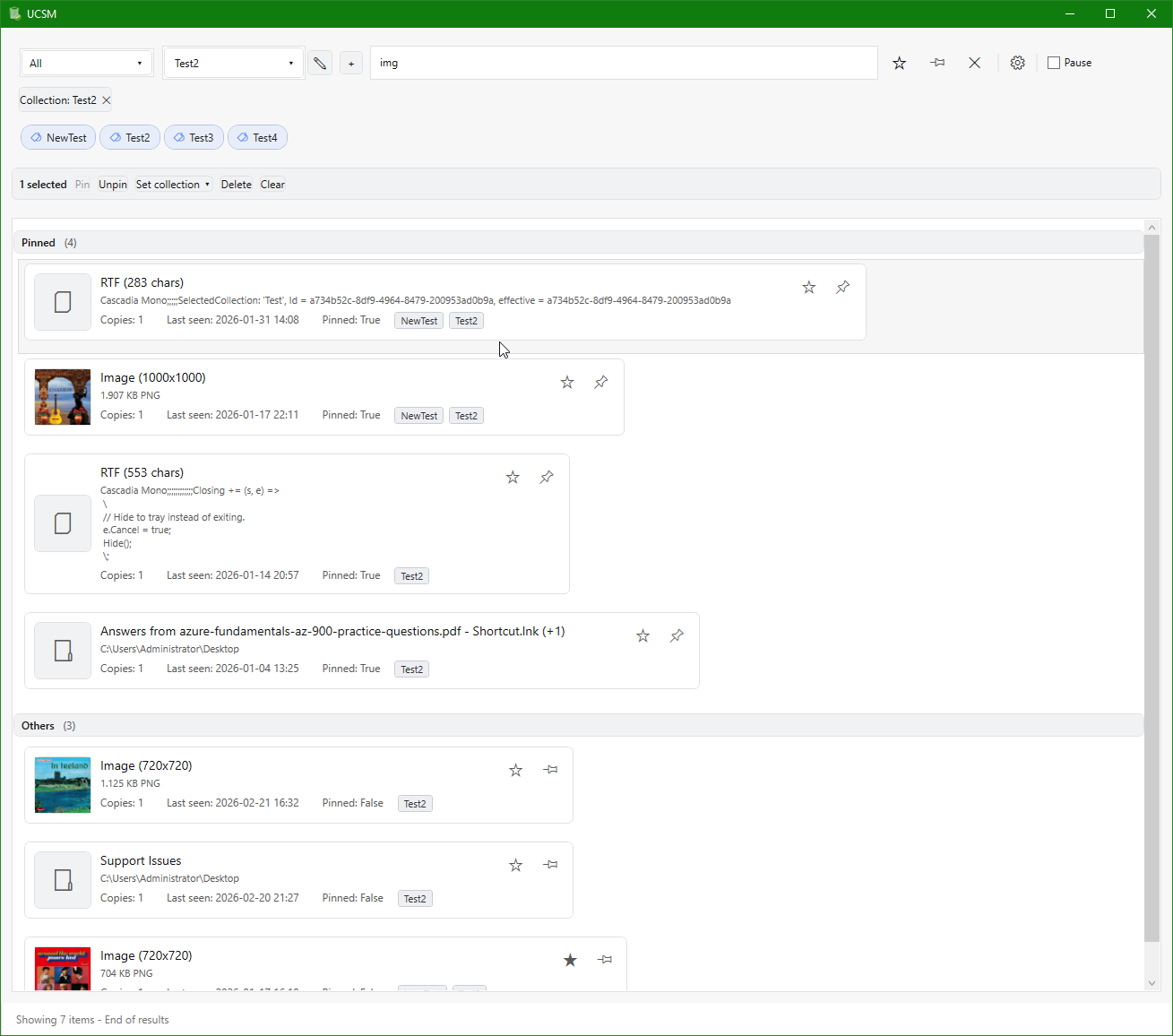
UCSM — Universal Clipboard & Snippet Manager

UCSM is a personal software product focused on capturing, organizing, searching, and reusing clipboard content efficiently. It is being developed as a structured .NET desktop application with strong emphasis on usability, responsiveness, and long-term maintainability.

Problem space

Clipboard history is often treated as a simple utility feature, but in practice it involves several non-trivial concerns: handling multiple data formats, supporting fast and flexible search, and enabling workflows where users repeatedly reuse and reorganize information.

Many existing tools solve parts of this problem, but often lack structure, scalability, or a consistent user experience. UCSM is an attempt to approach clipboard management as a proper product rather than a small utility.

Design approach

The system is designed using a layered architecture that separates Domain, Application, Infrastructure, and UI concerns. The goal is to keep the core logic independent of both presentation and storage details, allowing the system to evolve without tight coupling.

  • C#, .NET, WPF, and XAML
  • SQLite-based persistence with search-oriented capabilities
  • Clear separation of concerns across architectural layers
  • Focus on responsiveness and predictable user interactions

Key technical considerations

  • Designing for high-frequency operations such as capture, search, and filtering
  • Ensuring UI responsiveness while handling continuous clipboard updates
  • Structuring the codebase to support incremental feature growth
  • Balancing simplicity with flexibility in the data and interaction model

Selected design decisions

A project like UCSM involves many small and large decisions that influence how well the system can grow over time. Some of the most important choices have been about keeping the architecture clear, the user experience responsive, and the implementation flexible enough to support future refinement.

  • Layered architecture: I chose to separate Domain, Application, Infrastructure, and UI concerns so the core behavior of the system is not tightly bound to presentation or storage details. This makes the application easier to reason about, test, and evolve.
  • WPF for the desktop UI: WPF is a strong fit for a rich Windows desktop experience where responsiveness, data binding, and interaction design matter. It allows the interface to remain expressive without forcing the core logic into UI-specific shapes.
  • SQLite for persistence: SQLite provides a lightweight and practical storage model for a desktop application while still supporting robust local persistence and efficient querying. It is a good match for a product that needs structured storage without unnecessary operational complexity.
  • Search as a first-class capability: Since the value of the product depends heavily on retrieving information quickly, search is not treated as an afterthought. The design places strong emphasis on enabling fast filtering, findability, and practical reuse.
  • Incremental refinement: Rather than trying to finalize everything up front, I have approached the product in a way that allows architecture and implementation to improve together over time. That makes it easier to respond to real needs without sacrificing structural quality.

Engineering practices

The project is developed with a strong focus on maintainability and clarity. Refactoring is treated as an ongoing activity rather than a one-time effort, and the structure of the code is continuously improved as the system evolves.

  • Emphasis on clear boundaries and low coupling between components
  • Use of testing to support confidence in changes and refactoring
  • Consistent naming and organization to improve readability
  • Focus on long-term code health rather than short-term convenience

Current focus

The project is actively evolving, with ongoing work focused on improving both usability and internal structure. The goal is to refine the application in a way that strengthens its practical value while keeping the architecture clean and adaptable.

  • Refining search and filtering to support faster and more intuitive workflows
  • Improving UI responsiveness and interaction flow in the main views
  • Strengthening internal structure through targeted refactoring
  • Expanding support for organizing and reusing clipboard content effectively

Outcome and value

UCSM serves both as a useful tool and as a demonstration of how I approach software engineering in practice. It reflects a balance between architecture and usability, showing how a system can be structured to remain robust and adaptable over time.

  • A non-trivial desktop application designed and built from the ground up
  • Practical application of architectural principles in a real product
  • A maintainable and extensible foundation for future development
  • Focus on delivering real user value alongside technical quality

Enterprise Desktop Systems

Over the years, I have worked on a range of commercial Windows desktop applications in professional environments where reliability, maintainability, and alignment with business needs were essential.

Much of this work has been for customer-owned systems, so I cannot publish the full implementations publicly. However, the common thread has been the same: understanding real workflows, building robust solutions, and maintaining technical quality over time.

Typical contributions

  • Designing and implementing application features in C# and .NET
  • Improving structure in existing codebases through refactoring and clearer boundaries
  • Balancing new development with stability and maintainability
  • Translating business needs into practical and usable desktop software

Architecture and Modernization

A recurring theme in my work has been helping software become easier to understand, safer to change, and better prepared for future growth. This includes both building systems well from the start and improving existing systems that need stronger structure.

I am particularly motivated by work where architecture is not just documentation, but something that actively improves delivery quality, maintainability, and confidence in change.

Typical focus areas

  • Introducing clearer separation of concerns
  • Improving testability and reducing hidden coupling
  • Refactoring toward more maintainable and comprehensible designs
  • Supporting long-term quality without losing sight of practical delivery