Testing Behavior Without Testing Implementation Details
Testing · 2026-08-06
A practical look at writing tests that protect meaningful behavior without freezing implementation details, so the code can be refactored and improved without creating noisy test failures.
Testing Behavior Without Testing Implementation Details
1. Tests Should Describe What Matters
A good test should make the important behavior visible.
It should tell a future reader what the code is expected to do, which outcome matters, and what kind of change would be considered wrong. When a test is written well, it becomes more than a safety net. It becomes a small description of the system’s intended behavior.
That is one of the reasons tests are valuable.
They do not only catch mistakes. They also explain intent.
But tests can easily start explaining the wrong thing.
A test may verify that a specific method was called, that a particular collection was used, that an internal helper received a certain value, or that a workflow executed its steps in exactly the current order. Those details may be true today, but they may not be the behavior the system actually promises.
When that happens, the test becomes tightly attached to the implementation.
It still protects something, but it may not protect the thing that matters most.
For example, if a service is responsible for publishing an article, the important behavior may be that an approved article becomes visible at the correct time, that an unapproved article cannot be published, or that a scheduled article is not shown too early. Those are meaningful outcomes. They describe what the system should do from the point of view of the application.
A weaker test might instead assert that one private helper was used, that a specific repository method was called before another, or that a particular internal flag changed in the middle of the operation. Those details may support the current implementation, but they are not necessarily the behavior that callers or users rely on.
That distinction matters when the code changes.
If the behavior stays the same but the implementation becomes simpler, the test should usually continue to pass. If a developer improves the internal structure, extracts a helper, changes a loop into a query, replaces one collaborator with another, or simplifies the workflow, the test should not fail merely because the code is shaped differently.
A behavior-focused test gives room for refactoring.
An implementation-focused test often resists it.
This does not mean tests should be vague. A behavior-focused test can still be precise. It can arrange a meaningful scenario, execute the public operation, and assert the exact outcome that should result. The precision is aimed at the contract, not at every internal step taken to fulfill it.
That is the key difference.
The test should describe what matters about the behavior, not everything that happens inside the implementation.
This is especially important in application code, where methods often coordinate several smaller decisions. A test that mirrors every internal step can make the workflow difficult to change. A test that focuses on the observable result can still protect the use case while allowing the structure to improve.
A useful question to ask when writing a test is:
If I changed the implementation but kept the behavior the same, should this test still pass?
If the answer is yes, the test should avoid depending on implementation details that may change during refactoring. If the answer is no, the detail being asserted should probably be part of the contract, not merely part of the current implementation.
That question helps keep tests honest.
Tests should make it harder to break important behavior. They should not make it harder to improve the code for the wrong reasons.
When tests describe what matters, they become a form of design documentation.1 They show the scenarios the code must handle, the outcomes that matter, and the responsibilities that should remain stable as the implementation evolves.
That is the foundation for testing behavior without testing implementation details.
2. The Difference Between Behavior and Implementation
Behavior is what the code promises from the outside.
Implementation is how the code keeps that promise on the inside.
That sounds simple, but in tests the distinction can become blurred. A test is close to the code. It often sees collaborators, method names, data structures, intermediate values, and control flow. Because those things are visible, it is tempting to assert on them.
But visibility does not automatically make something part of the behavior.
For example, a method may validate a request, load an entity, apply a rule, save a change, and return a result. The behavior may be that invalid requests are rejected, missing entities produce a not-found result, and valid changes are persisted. The implementation is the particular sequence of helper calls, repository calls, mapping steps, and internal branches used to make that happen.
Both matter.
But they do not matter in the same way.
Behavior is the reason the code exists. Implementation is the current way that behavior is achieved. A test that focuses on behavior protects the intent. A test that focuses too much on implementation protects the current shape of the code.
That difference becomes important during refactoring.
If a developer changes the internal structure but keeps the same observable outcome, a behavior-focused test should usually remain green. The code may use a different helper, a different loop, a different query shape, or a different internal data structure. If the public responsibility is unchanged, the test should not care.
An implementation-focused test often does care.
It may fail because a method was no longer called, because a collaborator was used in a different order, because an intermediate value was no longer exposed, or because the implementation became simpler and the old internal step disappeared.
The test is then no longer only protecting behavior.
It is protecting the old design.
This does not mean implementation details are always irrelevant. Some details are part of a contract at one level of the system. A repository implementation may need tests that verify query behavior. A serializer may need tests that verify the exact output format. A caching component may need tests that verify when cached values are reused or invalidated. In those cases, what looks like an implementation detail from one perspective may be the actual behavior of that component.
The level matters.
A detail that is internal to an application service may be public behavior for a lower-level component. A database query is usually an implementation detail of a use case, but it may be the central behavior of a repository method. An HTTP status code may be an implementation detail behind an adapter, but it may be a required output of an API endpoint.
That is why tests should be written from the perspective of the responsibility being tested.
When testing an application service, the important question is usually whether the use case produces the correct outcome. When testing a repository, the important question may be whether the correct data is retrieved or persisted. When testing an API endpoint, the important question may include the HTTP response shape. When testing a formatter, the exact text may be the behavior.
The same fact can therefore be behavior in one test and implementation detail in another.
This is one reason testing advice can become confusing. “Do not test implementation details” is a useful principle, but it does not mean “never test anything internal to the whole system.” It means the test should not reach below the level of responsibility it claims to verify.
A behavior-focused test has a clear point of view.
It asks: from this level, what should be true when the code has done its job?
That point of view helps decide what to arrange, what to execute, and what to assert. It keeps the test focused on the contract at that level instead of every mechanism used to fulfill it.
For example, if the test is about scheduling an article for publication, it should probably care that the scheduled article is not visible before the publish time and becomes visible when the time has arrived. It should not necessarily care which helper calculated the time comparison, unless that helper is being tested directly.
If the test is about the helper itself, the calculation is the behavior.
If the test is about the publication workflow, the helper is only a means to an end.
That distinction keeps tests more durable.
It allows implementation to change without weakening the protection around behavior. It also makes failures easier to understand. When a behavior-focused test fails, the failure usually points to something meaningful: a rule no longer holds, an outcome changed, a contract was broken. When an implementation-focused test fails, the failure may only say that the code no longer looks the way the test expected.
Both kinds of failures can be useful.
But only one should happen when the behavior is still correct.
The practical goal is not to draw a perfect theoretical line between behavior and implementation. The goal is to make each test honest about the responsibility it protects. A test should know which level it is testing, and its assertions should stay at that level.
Behavior is the promise.
Implementation is the current path to keeping it.
A good test should usually protect the promise without freezing the path.
3. Why Implementation-Focused Tests Feel Safe at First
Implementation-focused tests often feel reassuring when they are first written.
They are concrete. They can see the code’s internal steps. They can verify that the expected collaborator was called, that a helper was used, that a specific branch was taken, or that a particular value moved through the workflow in the expected way.
That can feel like strong protection.
The test seems to say: not only did the operation finish, but it followed the path we expected.
In some situations, that kind of detail is useful. If the responsibility being tested is the collaboration itself, the interaction may be part of the behavior. If a component is explicitly responsible for calling another component, recording an event, sending a command, or avoiding an expensive operation, then verifying that interaction may be appropriate.
But many implementation-focused tests go further than that.
They begin to assert details that are only true because of the current design.
A test may verify that a service calls ValidateAsync before SaveAsync. It may assert that a repository method is called exactly once. It may check that an internal mapper is used. It may verify that one helper method is called instead of another. It may inspect intermediate state that no caller actually relies on.
Those assertions can make the test feel thorough.
But they may also make it fragile.
The problem is that implementation details are often the very things we want to be able to change. A developer may inline a helper, split a method, combine two repository calls, change the order of two independent operations, replace a mapper, or simplify the workflow. If the observable behavior remains the same, those changes should usually be safe.
An implementation-focused test may disagree.
It may fail even though the use case still works.
That kind of failure feels safe at first because it catches change. But not every change is a defect. Some changes are improvements. Some are refactorings. Some are simplifications. Some remove unnecessary steps. A test that treats every internal change as suspicious can make the code harder to improve.
This is where false confidence appears.
A test may be very specific and still protect the wrong thing. It may prove that the code follows the current path, but not that the path produces the right outcome. It may verify that a collaborator was called, but not that the workflow result is correct. It may confirm that a helper was used, but not that the user-visible behavior still makes sense.
The test is precise, but its precision is pointed inward.
That can be especially tempting when using mocks.
Mocks make it easy to verify interactions. They can say that a method was called with specific arguments, called once, called in a specific order, or not called at all. Used carefully, that is valuable. Used too broadly, it turns many tests into descriptions of the current implementation rather than descriptions of expected behavior.
The test becomes a script of how the code works today.
Then, when the implementation changes, the script has to be rewritten.
This creates a subtle maintenance cost. The developer making a refactoring must also update tests that did not fail because behavior changed, but because the old implementation was encoded into the test. Over time, this can teach developers to avoid refactoring. The tests feel like they are protecting the system, but they are also protecting accidental structure.
That does not mean interaction testing is bad.
It means interaction testing should be deliberate.
If the interaction is the behavior, test it. If the interaction is only one possible way to achieve the behavior, prefer testing the outcome. The difference is not always obvious, but the question is useful:
Would this test still matter if the same result were produced in a different way?
If the answer is no, the assertion may be tied to implementation rather than behavior.
Implementation-focused tests feel safe because they are close to the code. They show activity. They make the internal path visible. They catch changes quickly.
But good tests should do more than catch change.
They should help distinguish harmful change from harmless change.
A test that fails when behavior is broken is useful. A test that fails whenever the implementation changes may become a barrier to improvement. It forces the code to keep looking the same even when the same behavior could be achieved more clearly.
The safest test is not always the one that knows the most.
Often, it is the one that knows exactly enough to protect the behavior that matters.
4. When Tests Know Too Much
A test knows too much when it can no longer tolerate reasonable change.
The behavior may be the same. The public contract may still be intact. The user-facing result may not have changed. But the test fails because an internal detail moved, disappeared, or was expressed differently.
That is often a sign that the test has crossed a boundary.
It is not only verifying what the code should do. It is verifying how the code is currently arranged.
This can happen in several ways.
A test may know too much about call order. It may require two collaborators to be called in a specific sequence even though the sequence is not part of the behavior. It may know too much about helper methods. It may require a particular helper to be used even though another implementation would produce the same result. It may know too much about internal state. It may inspect a value that only exists halfway through the operation.
Each of those details may be real.
But not every real detail deserves to be part of the test.
For example, a test for publishing an article should probably care whether the article becomes visible when it should. It may care that an unapproved article cannot be published. It may care that a scheduled article is held back until its publication time.
But it should be careful about caring which internal method performed the date comparison, whether the workflow used one repository call or two, or whether the implementation first checked approval and then checked time rather than the other way around.
Those choices may change during refactoring.
The behavior should not.
When tests know too much, small internal improvements create unnecessary failures. A developer may simplify a workflow and still have to rewrite several tests. A private helper may be removed, and tests fail even though the behavior is clearer than before. A loop may be replaced with a query, and tests fail because they expected the old interaction pattern.
That kind of failure is noise.
It does not tell us that the system is wrong. It tells us that the test was too attached to the previous shape of the system.
The danger is not only maintenance cost. Over time, tests that know too much can discourage good design changes. Developers learn that improving internal structure is expensive because the tests resist every change. The test suite becomes a guard against regression, but also a guard against simplification.
That is not the balance we want.
A useful test should give confidence to refactor. It should say: you can change the internal path as long as the important behavior remains true.
A test that knows too much says something different: you can change the code only if it still looks like it did before.
This does not mean tests should be blind.
A test should know the responsibility it is protecting. It should know the scenario, the inputs, the operation being executed, and the outcome that matters. It should be precise about those things.
The problem starts when the test also knows things outside that responsibility.
If a test for an application service knows provider-specific status codes, it may be testing below the application level. If a test for a workflow knows the internal query structure of a repository, it may be testing persistence mechanics instead of behavior. If a test for a public operation depends on a private helper name, it is almost certainly too close to the implementation.
The level of the test should decide what it is allowed to know.
At the application level, the test should usually know application scenarios and outcomes. At the infrastructure level, it may need to know provider details, database behavior, or file system conditions. At the formatting level, exact output text may matter. At the API boundary, status codes and response shapes may be part of the behavior.
The same detail can be legitimate in one test and excessive in another.
That is why the question is not simply whether a test uses mocks, calls collaborators, or checks internal data. The better question is whether the test knows more than it should for the level of responsibility it is testing.
If it does, the test becomes fragile.
It will fail when the code changes shape, even if the system still behaves correctly.
A good test should not know everything.
It should know the thing that matters.
5. Testing Through Public Outcomes
One of the simplest ways to avoid testing implementation details is to test through public outcomes.
A public outcome is something the code is responsible for making true from the outside. It may be a returned result, a changed state, a saved record, a published event, a visible item, a validation error, or a response sent back to a caller.
The important point is that the outcome belongs to the contract.
It is something the caller can observe or depend on.
For example, if a workflow is responsible for approving an article, the test should usually care whether the article becomes approved, whether invalid input is rejected, whether the right failure result is returned, and whether the article can then appear in the places approved articles are supposed to appear.
Those are public outcomes.
They describe what the workflow means.
The test does not necessarily need to know every internal step used to produce those outcomes. It may not need to know which helper performed the validation, which internal branch was taken, or whether the workflow used one repository call or two. Those details may matter inside the implementation, but they are not always part of the behavior being promised.
Testing through public outcomes gives the implementation room to change.
The code can be refactored, simplified, reorganized, or optimized while the test continues to protect the same responsibility. If the outcome stays correct, the test should usually stay green. If the outcome changes, the test should fail for a meaningful reason.
That is the kind of failure we want.
A behavior-focused test often has a simple shape:
Arrange a meaningful scenario.
Execute the public operation.
Assert the outcome that matters.
The scenario should be described in the language of the use case. The operation should be the one the caller would actually use. The assertion should describe the result that proves the behavior is correct.
For example:
Given an article that is approved and scheduled for the future
When visible articles are requested
Then the scheduled article is not included yet
That test says something meaningful about the system. It does not say how the visibility rule is implemented. It says what must be true from the perspective of the behavior.
A more implementation-focused version might assert that a particular date helper was called, or that a repository method received a specific internal flag. That may prove something about the current code path, but it says less about the behavior that matters to the application.
The public-outcome version is usually more durable.
It also reads better.
A future developer can understand why the test exists without first understanding the internal structure of the code. The test describes a scenario and an expected result. That makes it useful as documentation as well as protection.
This does not mean every test must go through the outermost user interface or the full system boundary. Public is relative to the level being tested. For an application service, the public outcome may be its returned result and the state it saves through its collaborators. For a repository, the public outcome may be the data it returns or persists. For a formatter, the public outcome may be the exact string it produces. For an API endpoint, the public outcome may be the HTTP status code and response body.
The principle is the same at each level.
Test the behavior that the unit is responsible for exposing.
Avoid reaching past that boundary unless the detail is part of the responsibility being tested.
This is also why assertions should usually be written in terms of outcome rather than process. Instead of asserting that validation was called, assert that invalid input is rejected. Instead of asserting that a mapper was invoked, assert that the returned result has the expected shape. Instead of asserting that a repository method was called in a certain order, assert that the correct state was persisted or that the workflow returned the correct result.
The outcome is what the caller cares about.
The process is often only one possible way to get there.
There are exceptions. Sometimes the interaction is the outcome. If a component’s job is to send a message, publish an event, write a file, or call an external boundary, then verifying that the boundary was used may be appropriate. But even then, the test should usually describe the interaction in application-level terms: a message was queued, a notification was sent, a change was saved, an event was published.
It should not unnecessarily expose every internal step leading to that interaction.
Testing through public outcomes also improves confidence during refactoring. When tests are written this way, a developer can change the internal design and rely on the tests to catch behavior changes. The tests become a safety net for intent, not a lock around structure.
That is what makes them valuable.
They protect the behavior while letting the implementation breathe.
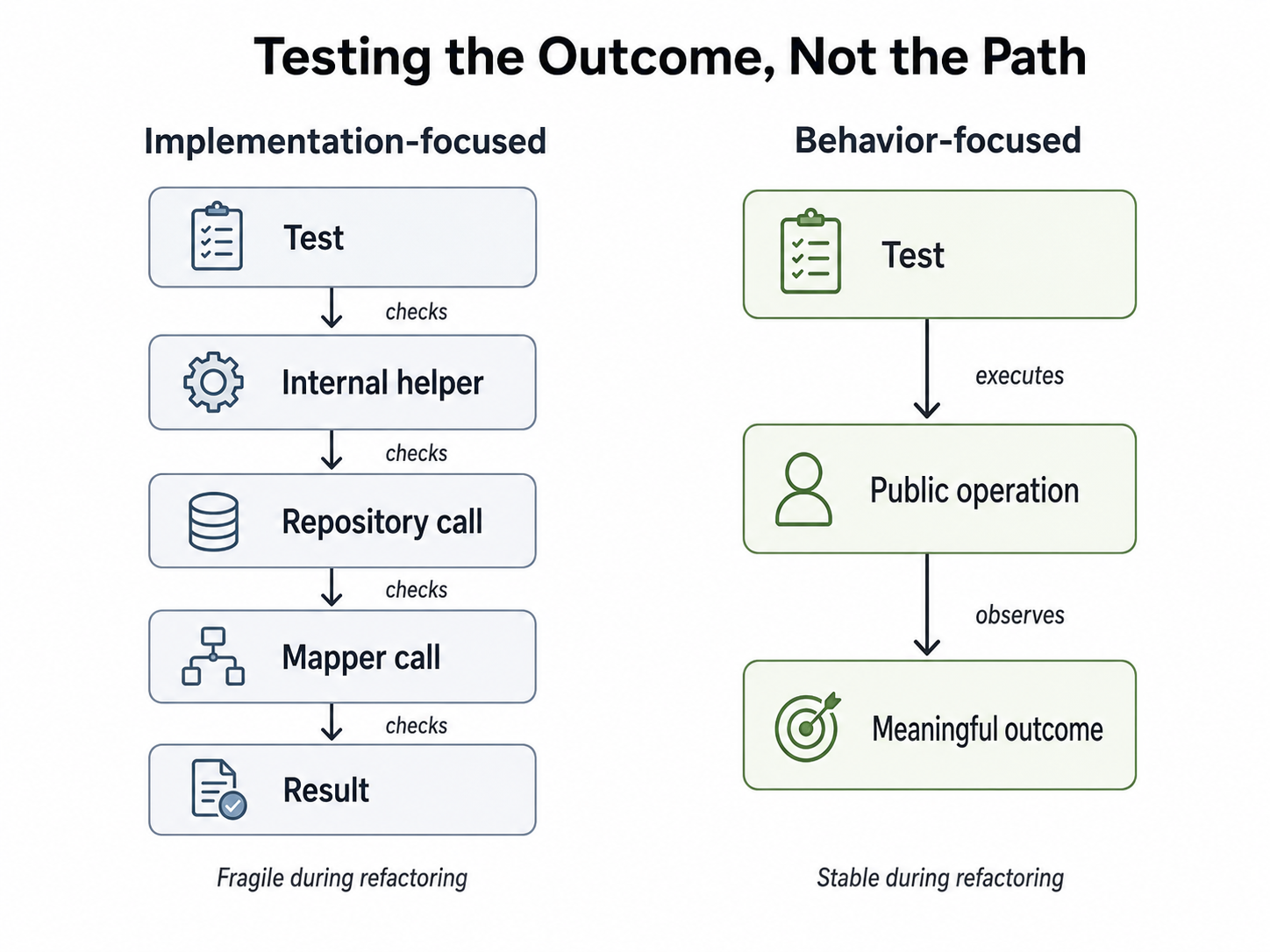
A behavior-focused test observes the outcome the code promises, while an implementation-focused test follows the internal path used to produce it.
6. Assertions Should Match the Responsibility Being Tested
A test is shaped by its assertions.
The arrangement may describe a scenario. The action may execute the code. But the assertions reveal what the test believes is important.
That makes assertions a good place to look for implementation-detail problems.
If the assertions focus on the responsibility being tested, the test usually becomes clearer and more durable. If the assertions reach below that responsibility, the test may start depending on internal structure rather than behavior.
For example, a test for an application service should usually assert the outcome of the use case. Did the command succeed? Was the request rejected? Was the item found? Was the state changed correctly? Was the appropriate application-level result returned?
Those assertions match the responsibility of the application service.
A test for a repository has a different responsibility. It may need to assert that a specific kind of data can be retrieved, that filtering works as intended, or that a persisted change can be read back. A test for a formatter may need to assert exact text. A test for an API endpoint may need to assert status codes, response bodies, redirects, or validation messages.
Each test should assert at the level where the responsibility lives.2
Problems begin when assertions are written at the wrong level.
An application service test may assert the exact SQL-shaped query options passed into a repository. A workflow test may assert the order of internal helper calls. A test for a public method may inspect private intermediate state. A controller test may assert details of the service implementation instead of the HTTP response and application result.
Those assertions may pass.
They may even feel precise.
But they are precise about the wrong layer.
The question is not only whether an assertion is true. The question is whether the test should care that it is true.
A useful way to evaluate an assertion is to ask:
Is this the responsibility of the thing I am testing?
If the answer is yes, the assertion probably belongs in the test. If the answer is no, the assertion may belong in a different test, at a different level, or not at all.
For example, suppose an article publishing workflow must reject unapproved articles. A good application-level assertion might be that the result is rejected and the article does not become visible. That matches the use case.
A lower-level assertion might verify that ValidateApprovalStatus was called before SaveAsync. That may describe the current implementation, but it is not necessarily the responsibility of the workflow from the outside. The workflow’s responsibility is to enforce the rule, not to expose the exact internal sequence used to enforce it.
If the validation helper is complex enough to deserve its own tests, test it directly.
Do not make every workflow test depend on its existence.
The same applies to collaborators. It is sometimes reasonable to assert that a collaborator was used, but the reason should be clear. If the operation’s responsibility is to send a message, publish an event, or save a change, then verifying that the boundary received the correct request may be part of the behavior. But if the collaborator is only an internal convenience, asserting its use may freeze the implementation unnecessarily.
The distinction can be subtle.
A test should not avoid interaction assertions simply because mocks are involved. It should avoid interaction assertions when the interaction is not what the test is actually about.
For example:
Good reason to assert an interaction:
    The behavior is that a notification is sent.

Weak reason to assert an interaction:
    The current implementation happens to call a helper method.
In the first case, the interaction expresses a meaningful outcome. In the second, the interaction expresses a current design choice.
That difference affects how useful the test will be during change.
When assertions match responsibility, test failures are easier to interpret. A failing assertion usually means that the expected behavior no longer holds. Something important has changed.
When assertions depend on implementation details, failures can be ambiguous. The behavior may be broken, or the implementation may simply have changed shape. The developer then has to inspect the test to determine whether the failure represents a real regression or only an outdated expectation.
That weakens the signal from the test suite.
A good test suite should make important failures stand out. It should not bury them under failures caused by harmless refactoring.
Matching assertions to responsibility also helps keep tests smaller. When the test only asserts what the unit is responsible for, it does not need to verify every internal consequence. It can focus on the scenario and the meaningful result.
That does not mean every test should have only one assertion. Sometimes several assertions together describe one outcome. A result code, a returned value, and a persisted state may all be part of the same behavior. The issue is not the number of assertions. The issue is whether each assertion belongs to the responsibility being tested.
A test can have several good assertions.
It can also have one bad assertion that makes it fragile.
The goal is to make each assertion earn its place.
Before adding an assertion, it is worth asking whether the test would still be meaningful without it. If the answer is yes, the assertion may be adding noise. If the answer is no, ask whether the missing fact belongs to this level of behavior or a lower-level implementation detail.
That small habit can keep tests focused.
Assertions should not merely describe everything the code happens to do.
They should describe what the code is responsible for making true.
7. Fakes and Test Doubles Should Speak the Same Language as the Code
Test doubles are often introduced to make tests easier.
A dependency is replaced with a fake, a stub, a mock, or a recording implementation. The test can then focus on the code being tested without relying on a database, mail server, file system, HTTP provider, or other external mechanism.
That is useful.
But test doubles can also pull tests toward implementation details if they are shaped around the wrong language.
A fake should usually speak the same language as the code that uses it. If the application code works with application-level outcomes, the fake should make it easy to arrange those outcomes. If the workflow depends on NotFound, Conflict, DeliveryFailed, or TemporarilyUnavailable, the fake should allow the test to express those conditions directly.
The test should not have to simulate infrastructure details unless those details are the behavior being tested.3
For example, if an application service handles failed delivery, a fake sender can return DeliveryFailed. The test does not need to construct an SMTP exception, an HTTP timeout response, or a provider-specific payload just to reach that branch. Those details belong in tests for the infrastructure adapter, not in every application-level workflow test.
That keeps the test closer to the responsibility being tested.
The same idea applies to repositories. If the application workflow needs to handle a missing article, a fake repository can return a not-found result or no article. The test should not usually need to reproduce the exact database behavior that caused the article to be missing. It should arrange the application-level condition and assert the application-level outcome.
A good test double supports the test’s language.
A poor test double exposes the implementation’s machinery.
This distinction becomes especially important when mocks are used. A mock can verify that a method was called, how many times it was called, and which arguments were passed. That can be valuable when the interaction itself is the behavior. But if the mock forces the test to know every internal collaboration, the test can become a mirror of the implementation.
The test then says:
Call this dependency.
Then call this dependency.
Then pass this exact internal value.
Then return this exact intermediate result.
Sometimes that is necessary.
Often, it is a sign that the test double is too close to the implementation path.
A behavior-focused fake might instead let the test say:
Given the article exists
Given saving succeeds
When the article is published
Then the result is successful
Then the article is visible
That test is still precise. It still controls the scenario. It still protects the behavior. But it does not require the test to know every internal step used to produce the result.
One practical technique is to create small fakes that model meaningful outcomes rather than technical details.
A fake sender can record the messages it was asked to send. A fake repository can store entities in memory and return them through the same application-level contract as the real repository. A fake clock can provide a specific time. A fake current-user service can provide a known user. A fake event publisher can record which events were published.
Those fakes are not trying to imitate the full infrastructure implementation.
They are trying to support application scenarios.
That is usually enough.
In fact, a fake that imitates infrastructure too closely can become a problem. If an in-memory repository tries to behave exactly like a relational database, it may become complex without providing the same guarantees. If a fake provider reproduces every error code from an external API, application tests may become tied to provider behavior. If a fake mail sender exposes SMTP concepts, the tests may start speaking SMTP even though the application should not.
The fake has then become another path for infrastructure leakage.
A test double should simplify the boundary, not recreate all of its complexity.
This does not mean infrastructure behavior should be ignored. Provider mappings, database queries, serialization formats, and external response handling still need tests. But those tests belong closer to the infrastructure implementation. They should verify that the real adapter translates technical behavior correctly.
Application tests can then depend on the translated contract.
That separation makes the test suite easier to understand. Application tests describe use cases. Infrastructure tests describe integration behavior. Each test double supports the level where it is used.
It also makes tests easier to change.
If the real infrastructure implementation changes, application tests should usually not need to change as long as the application contract remains the same. The fake still returns the same meaningful outcomes. The workflow still handles the same scenarios. Only the infrastructure tests need to adapt to the new provider or storage mechanism.
That is a healthy testing boundary.
The test double does not hide behavior. It hides irrelevant mechanics.
When choosing or writing a test double, it is worth asking:
Does this double help the test describe the scenario in application terms,
or does it force the test to know how the dependency is implemented?
If it helps the test speak the application’s language, it is probably supporting behavior-focused testing. If it forces the test to arrange provider details, internal call sequences, or technical failure modes, it may be pulling the test below the level it should be testing.
Good test doubles make tests clearer.
They give the test enough control to arrange meaningful scenarios, but not so much exposure that the test becomes tied to implementation details.
They should help the test say what matters.
They should not make the test explain how everything works inside.
8. Avoiding Tests That Mirror the Implementation
A test can become too similar to the code it is testing.
This often happens when the test is written by looking at the implementation line by line. The production code does one thing, then another, then another. The test follows along and verifies each step. At first, that may seem thorough.
But the result can be a test that mirrors the implementation instead of describing the behavior.
The test no longer says, “given this scenario, this outcome should happen.” It says, “this method should proceed through the same internal path it currently uses.” That is a different kind of protection.
It protects the shape of the code.
Not necessarily the responsibility of the code.
This is especially easy to do when a method coordinates several collaborators. The implementation calls a validator, loads data, maps a request, applies a rule, saves a change, and returns a result. A mirror-style test may verify each collaboration in the same sequence. It may assert that each intermediate object looks exactly as expected. It may check every internal transformation even when only the final outcome matters.
That can make the test brittle.
If the workflow is simplified, the test fails. If two steps are combined, the test fails. If a helper is removed, the test fails. If the order changes but the behavior remains correct, the test fails. The test has become an echo of the current implementation, so any improvement to the implementation requires rewriting the echo.
A behavior-focused test takes a different approach.
It starts from the scenario.
What is true before the operation? What action is performed? What should be true after the operation? Which outcome would prove that the responsibility was fulfilled?
Those questions keep the test from simply copying the code’s internal structure.
For example, instead of testing that a publishing workflow calls a CheckApproval helper, then calls a scheduling helper, then calls a repository method, the test can describe the behavior:
Given an approved article scheduled for the future
When visible articles are requested
Then the article is not visible yet
That test does not mirror the implementation. It describes the rule.
The implementation may use a helper, a specification, a query, a domain method, or a direct condition. As long as the rule still holds, the test stays useful.
Another sign that a test mirrors the implementation is that it needs to change whenever the code is refactored, even though no requirement changed. This is often accepted as normal test maintenance, but it should raise a question. If a purely internal refactoring requires many test changes, the tests may be coupled to structure rather than behavior.
Some test changes are expected during refactoring.
But behavior-focused tests should usually survive more internal changes than implementation-focused tests do.
A useful technique is to write the test name before reading the implementation too closely. The name should describe the scenario and the expected behavior, not the internal method calls. A name such as Rejects_unapproved_article is usually better than Calls_validation_before_saving. The first name describes a rule. The second name describes a current sequence.
The test body should then support that name.
If the name says the article is rejected, the assertions should prove rejection. If the test instead spends most of its effort verifying which helper was called, the test name and the test body are pulling in different directions.
That mismatch is a useful warning sign.
Another technique is to remove assertions that do not affect the meaning of the test. A test may start with one important assertion and gradually collect others. Some are added because a value is available. Some are added because it seems harmless to check more. Some are added because the implementation exposes an intermediate object and the test can see it.
But more assertions do not always mean more useful protection.
They can make the test more sensitive to irrelevant change.
Each assertion should answer the same basic question: does this help prove the behavior the test is about? If not, it may be better placed in a different test, or omitted entirely.
It is also worth being careful with tests that reproduce the same algorithm as the production code. If the test calculates the expected result by following the same logic as the implementation, the test may not catch the error it is supposed to catch. Both the test and the production code can be wrong in the same way.
For simple calculations, this can be subtle.
For workflows, it often appears as arrangement logic that recreates the internal decision path. The test becomes difficult to read because it is doing nearly as much work as the code under test.
A good test should usually make the expected behavior clearer than the implementation.
It should reduce the scenario to the facts that matter.
This does not mean the test must be extremely short. Some behaviors require careful setup. Some scenarios need several pieces of data. Some outcomes need several assertions. But the test should still read as a scenario, not as a duplicate implementation.
The difference is in perspective.
A mirror-style test looks inward and asks whether the code followed the current path.
A behavior-focused test looks outward and asks whether the responsibility was fulfilled.
That outward perspective makes the test more valuable over time. It gives developers confidence to improve the internals without losing protection around the behavior. It also makes the test easier for future readers to understand, because they can see the rule being protected instead of reconstructing the implementation from the test.
Tests should not be shadows of the code.
They should be descriptions of the behavior the code must preserve.
9. Refactoring Should Not Break the Wrong Tests
One of the best reasons to have tests is to make refactoring safer.
A test suite should give developers confidence to improve the code. It should allow them to rename things, extract helpers, simplify workflows, replace collaborators, move responsibilities, and remove duplication while knowing that important behavior is still protected.
That is the ideal.
But sometimes the opposite happens.
A developer changes the internal structure of the code, keeps the behavior the same, and several tests fail. The tests did not fail because the system now produces the wrong result. They failed because the implementation no longer looks the way the tests expected.
That is a warning sign.
It means the tests may be protecting the wrong thing.
Refactoring is supposed to change implementation without changing behavior. If every internal change requires rewriting tests, the tests are too tightly attached to the implementation. They are not only checking what the code does. They are checking how the code is currently built.
That makes the test suite less useful as a refactoring safety net.
A good behavior-focused test should usually survive refactoring. If the public outcome is the same, the test should remain green. If the test fails, the failure should ideally mean that the behavior changed in a way that matters.
That kind of failure is valuable.
It tells the developer that the refactoring may not be safe after all.
An implementation-focused failure is different. It may say that a helper was renamed, that a dependency was no longer called, that a private step disappeared, or that a method now reaches the same outcome through a different path. That may be relevant in some tests, but it should not usually break tests that claim to protect application behavior.
The distinction matters because unnecessary test failures create friction.
When a harmless refactoring breaks many tests, developers learn to avoid refactoring. They may leave awkward code in place because changing it feels expensive. They may make smaller improvements than they should. They may update tests mechanically, without learning anything useful from the failures.
The test suite then becomes a drag on design improvement.
It still provides protection, but it also makes the codebase less flexible.
A useful refactoring test is this:
If I can change the implementation without changing the behavior,
how many tests fail?
If the answer is “almost none,” the tests are probably focused on stable behavior. If the answer is “many,” the tests may know too much about the internal structure.
This does not mean tests should never change during refactoring. Sometimes refactoring clarifies responsibilities, and tests should move with those responsibilities. A large method may be split into smaller components. A rule may be moved from an application service into a domain object. A provider-specific detail may be pushed behind an adapter. In those cases, some tests may be rewritten because the design boundary has changed.
That can be healthy.
But the reason for changing the tests should be that the responsibility has moved, not merely that the internal steps look different.
For example, if a validation rule moves from an application service into a domain method, the application-level test may still assert that invalid input is rejected. A new domain-level test may assert the rule more directly. The application test does not need to know the rule moved. It only needs to know that the workflow still rejects invalid input.
That is a good separation.
If the application test had asserted that a specific validation helper was called, it would fail during the refactoring even though the behavior remained correct. The test would have protected the old location of the rule rather than the rule itself.
Refactoring should break tests when behavior changes.
It should not break tests merely because behavior is now achieved in a cleaner way.
This is especially important when improving architecture. Many architectural improvements are invisible from the outside. A workflow may be simplified. Infrastructure concerns may be moved to an adapter. A result type may become clearer. A repository may hide persistence mechanics better. A service may stop knowing too much about its collaborators.
Those changes can make the system better without changing what callers observe.
A good test suite should allow that.
It should make it easier to improve the design, not harder.
When tests fail during refactoring, it is worth pausing before simply updating them. Ask what the failure means. Did the behavior change? Did the responsibility move? Or did the test depend on an internal detail that no longer matters?
That question helps separate useful failures from noisy failures.
A useful failure points to a broken promise.
A noisy failure points to a changed implementation.
The goal is not to eliminate every noisy failure. That may be unrealistic. Some tests will always sit close to implementation because they test lower-level components, infrastructure adapters, or performance-sensitive behavior. But the higher the test is in the application, the more careful it should be about depending on internal structure.
Application-level tests should usually be the tests that survive refactoring best.
They should protect the use case, not the current arrangement of helper methods and collaborators.
When tests have that shape, they become a design asset. They allow developers to improve the implementation with confidence. They make important behavior visible. They catch real regressions. And they reduce the fear that every internal improvement will create a long trail of unrelated test changes.
A test suite should not freeze the code in its current form.
It should protect the behavior while allowing the design to get better.
10. When Implementation Details Do Deserve Tests
Implementation details should not be ignored completely.
The point is not that every internal detail is unimportant. The point is that each test should be honest about the level it is testing. What looks like an implementation detail from one level may be the actual behavior of another.
That distinction is important.
A database query is often an implementation detail of an application workflow. The workflow should usually care whether the correct data is found, not whether the query used a specific include, join, or filter expression. But for a repository implementation, the query behavior may be exactly what needs to be tested.
A serialized JSON shape may be an implementation detail behind a service method. But for an API endpoint or message contract, the exact shape may be part of the public behavior.
A retry policy may be an implementation detail of an application use case. But for an infrastructure adapter responsible for communicating with an unreliable provider, retry behavior may be part of the responsibility.
The same detail changes meaning depending on where the test is placed.
That is why the advice “do not test implementation details” needs context. It should not mean that technical behavior is never tested. It should mean that a test should not reach below the responsibility it claims to verify.
Some components exist specifically to handle details.
A repository exists to handle persistence mechanics. A serializer exists to produce a specific representation. A mapper exists to transform one shape into another. A scheduler may exist to calculate timing. A cache may exist to avoid repeated work. A provider adapter may exist to translate provider-specific responses into application-level outcomes.
For those components, the details are not accidental.
They are the job.
If a repository method is supposed to return only articles that are visible at a certain time, that behavior deserves a test. If a storage adapter is supposed to translate a missing object into NotFound, that mapping deserves a test. If a mail provider adapter is supposed to map a temporary provider failure to TemporarilyUnavailable, that translation deserves a test. If a formatter is supposed to produce Markdown in a particular shape, the exact output may deserve a test.
Those tests may look detailed, but they are not necessarily implementation-focused.
They are testing the behavior of a lower-level responsibility.
The key question is whether the detail is part of the contract at that level.
For example, suppose an application service uses a sender abstraction. At the application level, the test may only need to arrange that sending fails and assert that the workflow handles the failure correctly. It should not need to know whether the failure came from SMTP, HTTP, or another provider.
But the SMTP sender itself should have tests for SMTP-specific behavior. It may need to verify how authentication failure is handled, how timeouts are translated, or how provider diagnostics are preserved. Those are implementation details of the application workflow, but they are behavior for the SMTP adapter.
That separation keeps both kinds of tests useful.
The application test stays focused on the workflow. The infrastructure test protects the technical mapping. If the provider changes, the infrastructure tests may need to change, but the application tests should remain stable as long as the application-level contract remains the same.
Implementation details also deserve tests when they represent important risk.
Some code is small but easy to get wrong. Date and time calculations, boundary conditions, parsing rules, file naming, sorting, filtering, and concurrency behavior can all contain subtle mistakes. If a helper or lower-level component owns one of those decisions, it can be useful to test it directly.
That does not mean every private helper needs its own test.
Often, private helpers are best tested through the public behavior that uses them. But if a piece of logic is important enough, complex enough, or reusable enough, it may deserve to become a named component with its own responsibility. Once it has that responsibility, testing it directly becomes more natural.
This is a good design signal.
If a test wants to reach deeply into a class to verify a detail, it may be showing that the detail wants a clearer home. Instead of testing private structure indirectly or awkwardly, it may be better to extract the decision into a small component whose behavior can be tested directly.
The test then no longer needs to break encapsulation.
It can test a real responsibility.
There are also cases where interaction details matter. If a component’s responsibility is to publish an event, send a notification, enqueue a command, or persist a change, then verifying that the interaction happened may be appropriate. The interaction is not merely a step on the way to the behavior. It is the behavior.
Even then, the assertion should be written at the right level.
A test might assert that a notification was sent to the expected recipient. It usually does not need to assert every internal method call that prepared the notification unless those steps are themselves meaningful responsibilities.
The same applies to performance-sensitive or safety-sensitive behavior. A cache may need tests that verify a value is not loaded twice. A transaction boundary may need tests that verify related changes are committed together. A security component may need tests that verify access checks are performed before sensitive data is returned.
In those cases, process can be part of behavior.
The important thing is to be deliberate.
Do not test a detail merely because the test can see it. Test it because, at the level being tested, the detail is part of the promise.
That discipline helps avoid two opposite mistakes.
The first mistake is testing everything through high-level behavior and leaving important lower-level rules unprotected. The second mistake is testing every internal step from high-level tests and making the suite fragile. A healthy test suite usually contains both behavior-focused application tests and more detailed tests close to the components where those details actually belong.
The goal is not to avoid detail.
The goal is to place detail in the right tests.
Implementation details deserve tests when they are the behavior of the component being tested, when they protect an important risk, or when they express a contract that other code depends on.
They do not deserve to be tested everywhere.
A good test suite lets each level protect its own responsibilities. Application tests protect workflows. Domain tests protect meaning and rules. Repository tests protect persistence behavior. Adapter tests protect translation and integration behavior. Formatter tests protect output shape.
That way, the same system can be tested thoroughly without making every test know everything.
Implementation details deserve tests when they belong to the responsibility being tested.
They become harmful when they leak into tests that should not have needed them.
11. How Behavior-Focused Tests Improve Design
Behavior-focused tests do more than protect existing code.
They can also improve the design of the code they test.
That happens because a behavior-focused test puts pressure on the public contract. It asks whether the code can be used in a clear way, whether the scenario can be arranged without too much technical noise, and whether the result can be asserted in language that matches the responsibility being tested.
If the test is hard to write, that may reveal something about the design.
A workflow that is difficult to test through its behavior may be exposing too many implementation details. It may require too much setup. It may depend on infrastructure concepts that do not belong at that level. It may return vague results. It may hide important outcomes behind exceptions, booleans, nulls, or side effects that are difficult to observe.
The test is then not only a verification tool.
It is feedback.
For example, if testing an application service requires creating provider-specific exceptions, configuring database options, or reproducing framework behavior, the service may be too close to infrastructure. If the test cannot express a failure scenario without knowing how a collaborator is implemented, the boundary may be too thin. If the assertion has to inspect internal state to prove the behavior, the public result may not be communicating enough.
Those are design signals.
Behavior-focused tests tend to reveal whether the code speaks the right language.
A good test for an application workflow should be able to arrange meaningful application conditions: the article is approved, the item is missing, delivery fails, the user is not allowed, the request is invalid, the dependency is temporarily unavailable. It should not need to arrange every low-level cause behind those conditions unless that low-level cause is the behavior being tested.
When that is difficult, the production code may need a better contract.
Perhaps a collaborator should return an application-level result instead of throwing a provider exception. Perhaps a repository should expose a clearer method. Perhaps a result type should distinguish NotFound from Conflict. Perhaps a rule should move into a domain object. Perhaps a clock, current-user provider, or external sender should be injected instead of reached directly.
The test helps make those needs visible.
This is one of the practical benefits of writing tests before or alongside the code. The test becomes the first caller. If the test has to work too hard, future callers may also have to work too hard. If the test reads clearly, there is a good chance the contract is easier to understand.
Behavior-focused tests also encourage smaller responsibilities.
When a class tries to do too much, its behavior becomes difficult to describe in a single test. The setup grows. The assertions multiply. The test name becomes vague. The test may need to cover validation, persistence, mapping, provider calls, and formatting all at once.
That is often a sign that the code has mixed responsibilities.
A more focused design usually produces more focused tests.
The application service coordinates the use case. The domain object protects a rule. The repository handles persistence. The adapter translates provider behavior. The formatter produces output. Each part can then be tested through the behavior that belongs to it.
This does not mean every class must be tiny.
It means responsibilities should be clear enough that the tests can describe them without confusion.
Behavior-focused tests also make result design more important. If a method only returns true or false, the test may have trouble expressing why something failed. If a method throws generic exceptions for expected outcomes, the test may become awkward. If a result type contains provider-specific details, the application test may start speaking infrastructure language.
A useful result type makes behavior easier to test.4
It lets the test assert that a request was rejected, that a conflict occurred, that the item was not found, or that delivery failed. Those assertions are both clearer and closer to the application meaning.
In that way, tests can push the design toward better communication.
They reward contracts that express meaningful outcomes.
They punish contracts that hide meaning or expose the wrong details.
Behavior-focused tests also make refactoring safer, which improves design over time. If tests are attached to behavior rather than implementation, developers can change internal structure with more confidence. They can extract methods, move rules, replace collaborators, simplify workflows, and improve naming without constantly rewriting tests that were never supposed to care about those details.
That freedom matters.
Design rarely becomes good all at once. It improves through many small changes. A test suite that supports those changes becomes part of the design process. A test suite that resists those changes can freeze the design too early.
This is especially important in long-lived systems.
Requirements change. Infrastructure changes. Names improve. Boundaries become clearer. Responsibilities move. A behavior-focused test suite gives the code room to adapt while still protecting the promises that matter.
It also improves communication between developers.
A test that describes behavior can be read as a small example of how the system should work. It explains the scenario, the operation, and the expected result. A test that mirrors implementation often requires the reader to understand the current internals before they can understand why the test exists.
That makes behavior-focused tests better documentation.
They describe the system in the language of its responsibilities.
When tests are written this way, they help shape better code. They encourage clearer boundaries, more useful result types, better abstractions, smaller responsibilities, and public contracts that express meaning rather than mechanics.
Good tests do not only confirm design decisions.
They reveal whether those decisions are usable.
That is why behavior-focused testing is not just a testing technique. It is also a design discipline.
12. Closing
Tests should give us confidence to change code.
That is one of their most important jobs.
They should make it safer to improve naming, simplify workflows, move responsibilities, replace infrastructure, clarify boundaries, and remove unnecessary complexity. They should help us see when behavior has been broken, without treating every internal change as a regression.
That only works when tests are focused on the right thing.
A test that describes behavior protects the promise the code makes. It says what should be true for a meaningful scenario. It shows the outcome that matters. It gives future developers a reason to trust that the responsibility still works, even if the implementation has changed.
A test that depends too heavily on implementation details protects something else.
It protects the current shape of the code.
Sometimes that is appropriate. Some components exist precisely to handle technical details, mappings, formatting, queries, interactions, or provider behavior. At that level, those details are part of the responsibility and deserve tests.
But when high-level tests know too much about low-level structure, the test suite becomes fragile. Refactoring becomes expensive. Good design changes create noisy failures. Developers may begin to avoid improving the code because the tests resist every internal movement.
That is not the kind of confidence a test suite should provide.
The goal is not to make tests vague.
Behavior-focused tests can be precise. They can arrange clear scenarios, execute the public operation, and assert exact outcomes. The difference is that their precision is aimed at the contract rather than the path taken through the implementation.
They test what must remain true.
They do not freeze every step used to make it true.
That distinction is especially valuable in application code. Workflows often coordinate validation, persistence, domain rules, provider boundaries, and result handling. If tests mirror each internal step, the workflow becomes hard to improve. If tests focus on meaningful outcomes, the workflow can evolve while its behavior remains protected.
A useful test often answers a simple question:
Given this situation,
when this operation is performed,
what should the caller be able to rely on?
That question keeps the test close to responsibility. It helps separate behavior from mechanism. It encourages better contracts, clearer result types, better fakes, and boundaries that expose application meaning rather than internal machinery.
It also makes tests easier to read.
A future developer should be able to understand why a test exists without reconstructing the entire implementation. The test should describe the scenario and the expectation. It should make the important behavior visible.
That is where tests become more than verification.
They become design documentation.
They show what the system promises. They reveal which outcomes matter. They make it easier to change the implementation without losing sight of the behavior the code must preserve.
Testing behavior without testing implementation details is not about ignoring how code works.
It is about choosing the right level of observation.
Look too far inside, and the test becomes brittle. Look only at vague outcomes, and the test may miss important responsibilities. The balance is to test each part of the system through the contract that belongs to that part.
Application tests should protect application behavior.
Infrastructure tests should protect infrastructure behavior.
Domain tests should protect domain meaning.
Formatter, mapper, adapter, repository, and API tests should protect the details that are genuinely part of those components’ responsibilities.
When each level tests what belongs to it, the test suite becomes stronger and calmer. It catches meaningful regressions. It supports refactoring. It documents behavior. It gives the design room to improve.
Good tests should make important behavior harder to break.
They should not make good code harder to write.
Want occasional updates?
Subscribe to receive occasional practical notes on .NET architecture, maintainable software, project progress, and new articles.